
Brain Training for Dogs Review: Does It Really Work?
Learn Brain Training for Dogs Review: Does It Really Work?
If your dog barks at every suspicious leaf, treats the sofa like a chew toy, ignores commands, or seems to have a PhD in selective hearing, you are probably looking for a training method that actually fits into everyday life.

That is where Brain Training for Dogs comes in.
Brain Training for Dogs is an online dog-training program created by Adrienne Farricelli, a professional dog trainer with a CPDT-KA certification. The program focuses on positive reinforcement, mental stimulation, and progressive brain games rather than punishment or dominance-based techniques. The official program currently describes 21 brain games organized into progressive levels, from beginner training through the advanced “Einstein” stage.
But is Brain Training for Dogs actually worth buying?
In this Brain Training for Dogs review, we’ll look at what the program is, how it works, what is included, the training levels, potential benefits, pros and cons, price, refund policy, customer feedback, and whether it is a good fit for your dog.

What Is Brain Training for Dogs?
Brain Training for Dogs is an online, self-paced dog-training program designed to combine obedience training with mental stimulation.
Instead of focusing exclusively on commands such as sit, stay, and come, the program uses games and problem-solving exercises to keep dogs mentally engaged.
The official website says the course contains 21 games and exercises, with the curriculum progressing through different levels of difficulty. It also provides written training material, demonstrations, and additional resources.
The program was created by Adrienne Farricelli, whose official bio identifies her as a professional dog trainer certified by the CCPDT. Her work has also appeared in publications including USA Today, Everydog Magazine, and the APDT Chronicle of the Dog.
One of the central ideas behind Brain Training for Dogs is simple:
A dog needs mental stimulation as well as physical exercise.
The program therefore uses games to encourage attention, problem-solving, patience, focus, and obedience.
It is delivered online, so there is no physical training kit that needs to be shipped to your home.
Why Choose Brain Training for Dogs?
There are plenty of free dog-training videos online. So why would someone pay for a dedicated program?
The biggest advantage is structure.
Instead of jumping between random YouTube videos, Brain Training for Dogs gives owners a progressive curriculum to follow.
1. Created by a Certified Professional Trainer
The program was created by Adrienne Farricelli, who is identified by the program as a CPDT-KA certified professional dog trainer.
That gives the program a more clearly defined training philosophy than anonymous online dog-training advice.
2. Focuses on Positive Reinforcement
The program emphasizes positive reinforcement rather than punishment or dominance-based training.
The official material describes the approach as force-free and reward-based.
3. Progressive Training System
The course is structured like a school curriculum.
Dogs begin with foundational exercises and gradually move toward more challenging activities.
This gives owners a roadmap rather than a random collection of tricks.
4. Mental Stimulation
Brain games can give dogs something productive to think about.
This can be particularly useful for dogs that become bored easily or need more enrichment in their daily routine.
5. Train at Home
You don’t have to drive to a training class every evening.
The course is online and can be followed at home using the available instructions and exercises.

How Does Brain Training for Dogs Work?
Brain Training for Dogs combines mental stimulation, positive reinforcement, problem-solving games, and progressive training exercises.
The idea is not simply to make your dog memorize commands.
Instead, many of the exercises encourage your dog to:
- Pay attention
- Follow cues
- Solve simple problems
- Control impulses
- Use their senses
- Learn new behaviors
- Repeat behaviors that receive rewards
The official program describes its approach as being based on positive reinforcement and mental stimulation.
A typical training session can involve a simple game where the dog has to figure something out to receive a reward.
As the dog becomes comfortable with easier exercises, the owner can move toward more challenging activities.
This progressive structure is one of the more interesting aspects of the program.
Brain Training for Dogs Levels
One of the main features of the program is its seven-stage structure.
The official course describes the levels as:
- Preschool
- Elementary School
- High School
- College
- University
- Graduation
- Einstein
Let’s look at what each stage is intended to accomplish.
Module 1: Preschool
Preschool provides the foundation for the training system.
The focus is on basic attention and communication between the dog and owner.
One important skill is teaching the dog to pay attention to the owner and respond appropriately to cues.
This stage is important because advanced exercises become much easier when a dog has learned how to focus.
Module 2: Elementary School
Elementary School introduces more mental stimulation.
The program includes games such as the Treasure Hunt, Muffin Game, and Ball Pit Game.
These activities are designed to encourage dogs to use their senses and think through simple challenges.
Module 3: High School
High School increases the difficulty.
The exercises focus more heavily on patience, impulse control, and settling down after excitement.
The official course mentions activities such as Jazz Up and Settle Down, the Bottle Game, and Bobbing for Treats.
Module 4: College
College introduces additional challenges involving focus, coordination, patience, and problem-solving.
Examples listed by the program include:
- Shell Game
- Open Sesame Game
- Magic Carpet Game
These exercises require the dog to pay closer attention to the task.
Module 5: University
At the University level, the exercises become more advanced.
The course includes activities such as Hide and Seek, which is intended to encourage interaction and engagement between dog and owner.
The program also includes training aimed at improving confidence and addressing unwanted behaviors.
Module 6: Graduation
Graduation focuses on more advanced obedience and movement-related skills.
The official course lists activities involving:
- Leg weaving
- Movement following
- Name recognition
At this point, the dog has already progressed through several layers of training.
Module 7: Einstein
Einstein is the final and most advanced level.
This section is designed around more challenging tricks and activities.
Examples include:
- Tidy Up Game
- Ring Stackers
- Play the Piano Game
These exercises are designed to give dogs more complex challenges after completing the earlier stages.

What Is Included With Brain Training for Dogs?
The program includes more than just the 21 main brain games.
The official program materials describe additional resources and bonus training content.
Depending on the current offer, the program can include:
1. 21 Brain Games
The main curriculum contains 21 progressive games and exercises.
2. Video Demonstrations
Video demonstrations help owners understand how individual exercises should be performed.
3. Written Training Guides
The program provides written material explaining the training process.
4. Obedience 101
This additional material focuses on foundational obedience skills.
5. Trick Training
The program also includes trick-training material covering behaviors such as:
- Shake hands
- Roll over
- Play dead
- Take a bow
- Howl
- Dance
6. Polishing Up Your Training
This material is designed to help owners refine skills after completing the main curriculum.
7. Adrienne’s Archive
The program’s resource material includes a collection of articles covering dog behavior and training topics.
Brain Training for Dogs Benefits
So what could you potentially get from using Brain Training for Dogs?
1. Better Mental Stimulation
One of the program’s biggest strengths is its emphasis on giving dogs something to think about.
Mental enrichment can complement normal walks and physical exercise.
2. Improved Focus
Many of the games require the dog to pay attention to the owner and the task.
Regular practice can help create more opportunities for focused behavior.
3. Better Obedience
The program combines games with obedience skills.
This makes training less like a repetitive command drill and more like an interactive activity.
4. More Problem-Solving Opportunities
Several exercises require dogs to figure out how to access a reward or complete a task.
This can provide additional cognitive enrichment.
5. Stronger Owner-Dog Bond
Training requires interaction.
When owners consistently reward desirable behavior, training can become a shared activity rather than a daily battle of wills.
6. Convenient Home Training
Because the program is online, owners can work through the lessons from home.
7. Suitable for Different Ages
The program is marketed for dogs across different ages and breeds. Current program information specifically describes it as suitable for puppies, adult dogs, and older dogs.
That said, individual exercises should always be adapted to the dog’s physical ability and temperament.

Brain Training for Dogs Pros and Cons
No online dog-training program is perfect.
Here’s the quick breakdown.
| Pros | Cons |
|---|---|
| Created by a CPDT-KA certified trainer | Requires consistent owner participation |
| Uses positive reinforcement | Results vary between individual dogs |
| 21 progressive brain games | Online format may not suit everyone |
| Seven progressive training levels | No substitute for hands-on professional behavior work |
| Includes additional training resources | Some owners may prefer live trainer feedback |
| Can be used at home | Serious behavior problems may require specialist help |
| Designed for different ages and breeds | Training takes time and patience |
| 60-day money-back guarantee is advertised | Current pricing and bonuses can change |
How to Use Brain Training for Dogs
The most important thing to remember is that dog training is a process.
Don’t rush through the program simply to reach the advanced levels.
A better approach is:
Step 1: Start With the Foundation
Begin with the introductory exercises.
Make sure your dog understands the basic behavior before moving forward.
Step 2: Keep Sessions Manageable
Short, focused training sessions can be easier for both the dog and owner than long sessions.
Step 3: Use Appropriate Rewards
Positive reinforcement generally involves rewarding desirable behavior.
Depending on the dog, rewards may include treats, toys, praise, or another appropriate reinforcer.
Step 4: Repeat Consistently
Dogs learn through repetition and reinforcement.
A single training session is unlikely to produce a permanent behavior change.
Step 5: Increase Difficulty Gradually
Don’t jump from an easy puzzle to the Einstein level because your dog solved one exercise quickly.
Build the skills progressively.
Step 6: Watch Your Dog
If your dog becomes frustrated, overwhelmed, tired, or loses interest, take a break.
Training should remain productive and enjoyable.
Is Brain Training for Dogs Good for Puppies?
It can be.
The program is marketed for dogs of different ages, including puppies.
Puppies can benefit from age-appropriate training, mental stimulation, and positive reinforcement.
However, puppy training should also include fundamentals such as:
- Toilet training
- Bite inhibition
- Socialization
- Handling
- Recall
- Basic cues
- Appropriate play
- Calm behavior
Brain games can complement these skills, but they shouldn’t replace basic puppy development and appropriate veterinary care.

Is Brain Training for Dogs Good for Older Dogs?
Older dogs can also benefit from mentally stimulating activities.
The key is to choose exercises appropriate for the dog’s physical condition.
For example, a senior dog with arthritis may not be comfortable with exercises involving lots of jumping or rapid movement.
Mental challenges can often be adapted to reduce physical demands.
If an older dog suddenly develops behavior or cognitive changes, however, speak with a veterinarian. A sudden behavioral change can sometimes have a medical cause.
Brain Training for Dogs Reviews
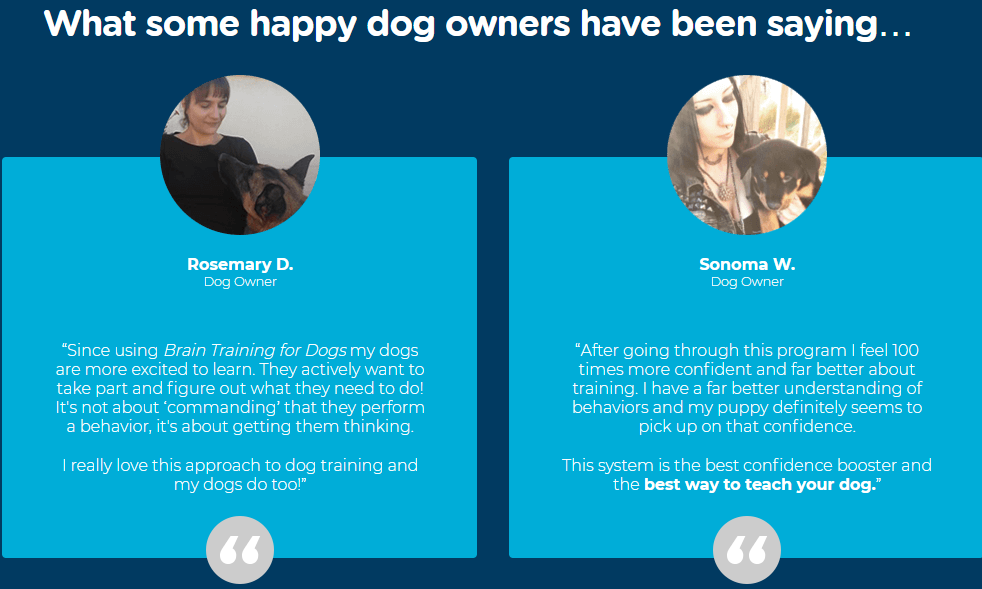
There are many Brain Training for Dogs reviews online, and overall sentiment is generally favorable.
For example, Canine Journal previously highlighted the program’s positive-reinforcement approach, progressive structure, trainer credentials, and money-back guarantee.
More recent review sites also commonly highlight the seven-level curriculum, 21 exercises, and home-based format.
However, there is an important caveat.
A large portion of online reviews are affiliate reviews.
That means the reviewer may receive a commission if you purchase the program through their link.
So don’t judge the program based on star ratings alone.
Instead, look at:
- What the program actually contains
- Who created it
- What training philosophy it uses
- Whether the exercises fit your dog
- Whether you can realistically follow the program
- The refund policy
That gives you a much clearer picture.
Is Brain Training for Dogs Legit?
Based on the available program information, Brain Training for Dogs appears to be a legitimate online dog-training course rather than an anonymous digital product.
The official website identifies Adrienne Farricelli as the creator and describes her professional dog-training credentials. The program also has a dedicated website with course resources, training material, and an affiliate program.
That said, legitimate does not mean guaranteed.
No dog-training course can guarantee that every dog will respond in exactly the same way.
Your dog’s:
- Age
- Breed
- Temperament
- Training history
- Environment
- Motivation
- Health
- Behavior problem
can all affect results.
Does Brain Training for Dogs Really Work?
This is where we need to separate reasonable expectations from marketing language.
Brain Training for Dogs can provide a structured way to practice positive-reinforcement training and mental enrichment.
But it would be unrealistic to promise that an online course will automatically eliminate every behavior problem.
A dog with mild boredom-related chewing may respond very differently from a dog with severe aggression, separation anxiety, fear, or reactivity.
For complex or dangerous behavior problems, an appropriately qualified professional should be involved.
So the better question isn’t:
“Will this magically fix my dog?”
The better question is:
“Does this give me a structured, humane training system that I can consistently use with my dog?”
For many owners, the answer may be yes.
Brain Training for Dogs Price
The price of Brain Training for Dogs can change depending on the current promotion and offer.
Recent published listings have shown prices around $47 to $67, while the official-style sales material currently found online advertises $67 in some offers.
Because digital-product pricing can change, we recommend checking the current official offer before purchasing.
Also check whether the current offer includes:
- Bonus training materials
- Lifetime access
- Any trial
- Refund protection
- Additional upsells
Don’t rely on an old screenshot showing a particular price.
Brain Training for Dogs Money-Back Guarantee
The current program information advertises a 60-day money-back guarantee.
This means buyers have a defined period in which they can evaluate the course.
Before purchasing, however, read the current terms carefully.
Check:
- How to request a refund
- The exact refund period
- Whether the refund covers the complete purchase
- Where refund requests should be sent
- Whether additional purchases have separate policies
The guarantee can reduce the financial risk of trying a digital training course, but it doesn’t eliminate the need to actually practice the training.
Where to Buy Brain Training for Dogs?
Brain Training for Dogs is available online.
The safest option is to use the official Brain Training for Dogs website rather than an unknown reseller.
The official site provides access to the course and its resources.
Before purchasing, verify the current:
- Price
- Bonuses
- Refund policy
- Access terms
- Checkout provider
- Course contents
This is especially useful because several third-party websites use similar names and may publish outdated or affiliate-generated information.
Who Is Brain Training for Dogs Best For?
Brain Training for Dogs may be a good fit if you:
- Want to train your dog at home
- Prefer positive-reinforcement methods
- Want structured exercises
- Have a bored or under-stimulated dog
- Want to improve basic obedience
- Enjoy interactive games with your dog
- Prefer self-paced learning
- Don’t want to attend regular in-person classes
It may be less suitable if you:
- Want one-on-one live trainer coaching
- Need immediate hands-on behavior intervention
- Have a dog with dangerous aggression
- Need specialized veterinary behavioral treatment
- Don’t have time to practice consistently
Frequently Asked Questions About Brain Training for Dogs
What is Brain Training for Dogs?
Brain Training for Dogs is an online dog-training program created by professional dog trainer Adrienne Farricelli. It uses progressive games, mental stimulation, and positive reinforcement to develop obedience and problem-solving skills.
Who created Brain Training for Dogs?
The program was created by Adrienne Farricelli, who is identified by the official program as a CPDT-KA certified professional dog trainer.
How many exercises are included?
The official website describes 21 brain games and exercises in the main program.
What are the seven Brain Training for Dogs levels?
The seven levels are Preschool, Elementary School, High School, College, University, Graduation, and Einstein.
Does Brain Training for Dogs use positive reinforcement?
Yes. The program emphasizes positive reinforcement and force-free training methods.
Is Brain Training for Dogs suitable for puppies?
The current program information says it can be adapted for dogs of different ages, including puppies.
Can older dogs use brain training for Dogs?
Yes. The program is marketed for dogs of different ages. Exercises should be adapted to the individual dog’s physical abilities.
Does Brain Training for Dogs require special equipment?
The program states that many exercises can be completed using simple household items or toys, so specialized equipment is generally not required.
How long does Brain Training for Dogs take to work?
There is no guaranteed timeframe. Progress depends on the dog’s temperament, training history, the owner’s consistency, and the difficulty of the behavior being addressed.
Is Brain Training for Dogs legit?
It appears to be a legitimate online training program with a named creator, published course materials, and a stated refund policy.
How much does Brain Training for Dogs cost?
Recent online listings have shown different promotional prices, including approximately $47 and $67. Check the current official offer because pricing can change.
Does Brain Training for Dogs have a money-back guarantee?
Yes. The current program information advertises a 60-day money-back guarantee.
Can Brain Training for Dogs fix aggressive behavior?
You should not rely on an online course alone for serious aggression or biting. These cases can require individualized assessment from a veterinarian and/or qualified behavior professional.